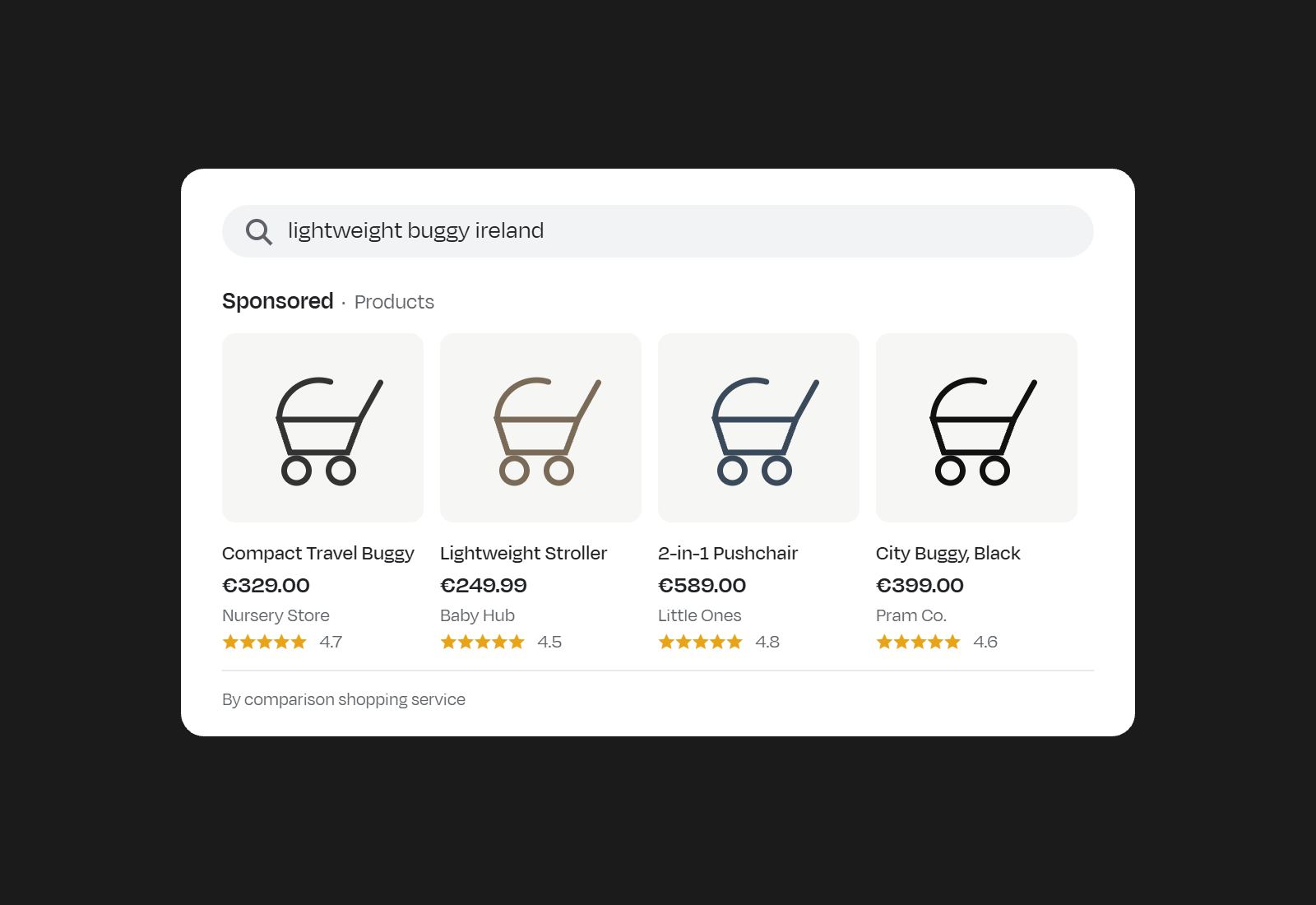
Ask most ecommerce owners about Google Shopping and they’ll describe the row of products at the top of a search. You pay per click, hope for sales, and when it stops working you turn the budget up or down.
That picture is a few years out of date. One product feed now decides whether you show up in Shopping ads, Performance Max, YouTube, Maps and the answers in Google’s AI Mode. Get the feed right and all of those work harder. Get it wrong and you pay for it everywhere.
Here’s what every online shop owner in Ireland should know about Shopping ads in 2026, and what we changed when we took over the account of an Irish nursery and baby-products retailer this year.
What are the types of Google Shopping ads?
There are four ways to pay for your products to show on Google: Standard Shopping, Performance Max, Demand Gen with a product feed, and local inventory ads. A fifth, Shopping ads inside Google’s AI answers, is rolling out country by country and on its way here.
They all run off the same Merchant Center feed. With Search ads you pick keywords and write the ad. With Shopping you do neither. Google reads your feed (title, description, price, images, stock) and decides which searches each product matches. Your feed is your keyword list and your ad copy at the same time.
Is Performance Max better than Standard Shopping?
Not automatically. Performance Max runs one campaign across every Google channel: Shopping, Search, YouTube, Display, Gmail, Discover and Maps. It can scale well, but you hand Google most of the decisions. Standard Shopping is slower to manage and shows you exactly which searches made you money.
Since late 2024, Performance Max no longer wins by default when both campaigns sell the same products. The one with the better Ad Rank serves. So a well-run Standard Shopping campaign can now take auctions PMax used to get automatically.
We saw it in the nursery account. Several Performance Max campaigns, split by price band and brand, were getting more budget every week and bringing in clicks, but not enough sales. Meanwhile a plain Standard Shopping “catch-all” campaign had been hitting its 775% return target. We moved money back to what was proven.
Newer isn’t the same as better.
Most accounts do best with both, each given a clear job:
- Standard Shopping: hero products and brand searches, where you want control.
- Performance Max: finding new customers across the rest of the catalogue.
- Every month: check the PMax channel report to see whether your money is going to Shopping or drifting into Display.
Why are Irish shops paying more for Shopping clicks than they need to?
Because most have never heard of a comparison shopping service, or CSS. Since an EU ruling in 2017, independent comparison shopping services can place Shopping ads in the same auctions as Google’s own. Google’s service keeps a margin on every click. An independent one doesn’t. Google has never published the margin, but in practice it’s up to 20%.
The nursery account was buying every Shopping click through Google’s own service. We moved the feed to an independent provider. Campaigns still run in Google Ads exactly as before.
The same clicks, for up to 20% less.
It matters even more since September. To comply with EU rules, Google removed free product listings from the main search results across Europe and gave that space to comparison shopping services. Your products can still show for free on the Shopping tab, Images, Maps and Lens, but for the main results page you now choose one CSS to represent you. One catch nobody mentions: that needs a separate standard Merchant Center account. It’s a short setup job, and we’ve done it.
What does Google actually look at in my feed?
Everything a shopper would. In the nursery account, three fixes did more than any bid change:
More pictures
Every product had one image. A buggy is a big purchase, and people want to see it from every angle before they click. We added more images to the feed so Google had more to show across Shopping, PMax and YouTube.
Best sellers in stock
Two of the best-selling products went out of stock, and performance dropped with them. When a product is unavailable, Google stops showing it. Stock on the top sellers is now the first thing we check.
Launches ready on day one
When a major new buggy launched, it only appeared in Shopping once it was in the feed. Within a day the top colour was getting a 5.5% click-through rate. A launch only works if the feed is ready before the embargo lifts.
Star ratings help too, once you have at least 50 product reviews across your catalogue.
Paying Google for clicks when your feed is the real problem? That’s usually the cheapest fix in the account.
What else is worth knowing?
YouTube can sell your products
Demand Gen campaigns show image and video ads on YouTube, Shorts, Discover and Gmail. Connect your feed and they become shoppable, with your products in a carousel under the ad. Judge them on new customers, not last-click sales, because their job is creating interest that Shopping then turns into orders.
Got a physical shop? Show your stock
Local inventory ads tell nearby shoppers a product is in stock at your store, with directions and opening hours. They’re available in Ireland and run from your existing Shopping or PMax campaigns, once your Google Business Profile is linked and your stock data is accurate.
AI Mode ads are coming
AI Mode, Google’s chat-style search, launched in Ireland in October 2025, and the products it recommends draw on your feed. Shopping ads inside it are live in the US, Google expanded them to ten more countries in October 2026, and the UK is next. Ireland won’t be far behind. They’ll run through your existing Shopping and PMax campaigns, so the work to do now is filling in product highlights, details and full descriptions.
Which Shopping setup is right for my business?
It depends on your catalogue, not on what Google recommends this month:
- A small catalogue with a few hero products: Standard Shopping, so you can see and control what each one earns.
- Hundreds of products and solid conversion tracking: Performance Max for reach, with Standard Shopping protecting your best sellers.
- Products people don’t know they need yet: add Demand Gen with your feed.
- A shop people can walk into: local inventory ads.
Whatever the mix, the order of work is the same: fix the feed, check the CSS, keep the best sellers in stock, then spend.
About the campaign lead
Luke McGregor is a Senior PPC Specialist at Vroom Digital with over 10 years’ experience in Google Ads. He runs the Google Shopping account in this article and works with Irish online retailers on Shopping, Performance Max and feed management.
FAQs: Google Shopping ads for Irish ecommerce
Is Performance Max better than Standard Shopping?
Not automatically. Performance Max reaches more places, but Standard Shopping gives you more control and can now win auctions against it on Ad Rank. Most accounts do best with both, each given a clear job.
What is a CSS and do I need one?
A comparison shopping service places your Shopping ads in Google’s auction. In the EU, using an independent one instead of Google’s own can make clicks up to about 20% cheaper. Since September 2026 it’s also how your products get into the free product spots on Google’s main results in Ireland.
Can I still get free listings on Google in Ireland?
Yes, on the Shopping tab, Images, Maps and Lens. On the main search results page, free product spots now go through a comparison shopping service you choose.
Will my products show in Google’s AI Mode?
They can already, for free, because AI Mode draws on your product feed. Paid Shopping ads in AI Mode are on their way, with the UK next in line. A complete feed is the best way to be ready.
Want Shopping ads that sell, not just get clicks? See how we run ecommerce PPC, or talk to us about your account.